

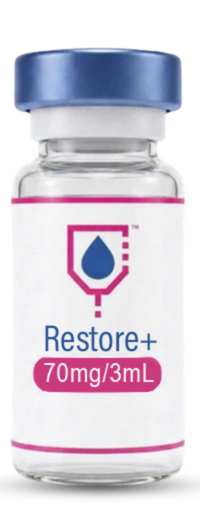
What Is Restore+?
A Three-Peptide Research Blend Studied for Tissue Signaling
Restore+ is a multi-peptide research formulation combining BPC-157, KPV, and GHK-Cu. Its 70 mg vial contains 50 mg BPC-157, 10 mg KPV, and 10 mg GHK-Cu. These compounds are investigated in experimental models for their distinct roles in tissue-repair signaling, inflammatory pathways, and extracellular-matrix regulation.
The combination attracts interest because it brings together several experimental mechanisms: BPC-157-related repair signaling, KPV-associated inflammatory-pathway modulation, and copper-peptide activity involving tissue remodeling. Restore+ is not an FDA-approved treatment for injury, inflammation, aging, or any medical condition.
Have questions about peptide therapy? Call Advanced Mobile IV to speak with our team.
What Researchers Are Studying
-
BPC-157 and Tissue-Repair Signaling
BPC-157 is investigated in experimental models for its interactions with tissue-repair processes, including signaling relevant to blood vessels and wound responses. These early observations do not establish that BPC-157 improves healing or recovery in humans.
-
KPV and Inflammatory Pathways
KPV is a short peptide studied for effects on inflammatory signaling in laboratory and preclinical settings. Researchers are exploring its interactions with pathways involved in immune responses. Those findings should not be confused with demonstrated clinical benefits for inflammatory conditions.
-
GHK-Cu and Extracellular-Matrix Remodeling
GHK-Cu is a copper-binding peptide studied for its relationship to collagen-associated processes, extracellular-matrix activity, and tissue signaling. The presence of copper in this complex contributes to its research interest, but does not establish that the Restore+ blend rejuvenates skin or repairs tissue.
Quick Answer
Restore+ combines three investigational peptides: BPC-157 (50 mg), KPV (10 mg), and GHK-Cu (10 mg), for 70 mg total per vial. Researchers study their biological actions in experimental systems. The formulation itself should not be presented as proven to accelerate healing, relieve inflammation, restore joints, or rejuvenate skin in people.
At a Glance

What it is
A 70 mg research blend of BPC-157, KPV, and GHK-Cu.

Why it attracts attention
Interest spans repair signaling, inflammatory pathways, and tissue remodeling.

What the evidence looks like
Mostly experimental ingredient-level research; clinical evidence for this blend is lacking.

Important context
Restore+ is not FDA-approved to treat injuries, inflammation, or aging.
What We Know - and What Remains Unclear
Restore+ may be described as a coordinated repair or recovery formula because its ingredients are associated with different experimental pathways. That framing can be misleading if it implies the three peptides have been shown to work better together in people.
Mechanistic overlap is not proof of synergy, and preclinical observations are not established human outcomes. The safety, appropriate administration, interactions, and long-term effects of this specific combination have not been adequately established in clinical trials. It should not be marketed as a proven regenerative therapy.
Anyone exploring peptide therapy should discuss the limited evidence, product quality, medical history, potential risks, and established treatment alternatives with a qualified healthcare professional before making decisions about an investigational formulation.
Wellness, Delivered With Care


Frequently Asked Questions
What peptides are in Restore+?
Restore+ contains BPC-157 (50 mg), KPV (10 mg), and GHK-Cu (10 mg), for a total of 70 mg per vial. It does not contain TB-500.
Is Restore+ proven to speed injury recovery?
No. Individual ingredients have been studied in experimental systems, but those findings do not establish that Restore+ accelerates recovery or heals injuries in people.
Does Restore+ reduce inflammation or improve skin?
KPV and GHK-Cu have attracted research interest for inflammatory signaling and tissue-related processes. Clinical benefits from this specific three-peptide formulation have not been demonstrated.
Is Restore+ FDA-approved?
No. Restore+ is not an FDA-approved medication or an established treatment for tissue damage, inflammation, or aging. Its safety and effectiveness as a combined formulation remain uncertain.
Learn More About Peptide Therapy
Peptide research is evolving, especially when several investigational compounds are combined. Advanced Mobile IV can help you understand the scientific questions surrounding Restore+ and other peptide formulations, the limits of current evidence, and what to discuss with a qualified provider.
Call Advanced Mobile IV to Learn MoreThis page is for educational purposes only and is not medical advice. Research and clinical understanding of peptide therapy continue to evolve.
AMIV Wellness Hub
Recent Blog Posts

Mobile IV
Jan 08, 2026
